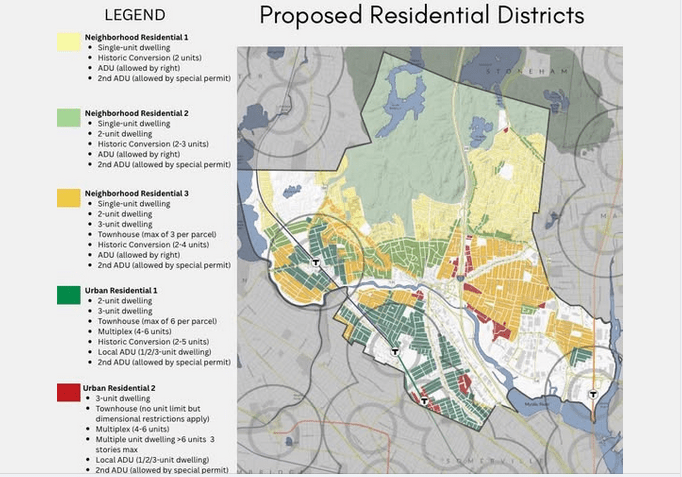
Within the past few weeks there have been two major developments in Medford’s rezoning saga. Both the Council President and Mayor have released statements in response to substantial public criticism of the current residential rezoning map proposal and the process of getting there.
Here is a summary of what has been said:
Council President: The Council President would like to turn to commercial. He would like to continue discussions on residential rezoning, ADUs, and off-street parking through the Spring of 2026. He wants the Community Development Board (CDB) to take a final vote on these matters between March and May of 2026. By September, he wants to have the Mayor submit to the Council for vote an appropriations request for $150,000 to extend the contract with the city’s zoning consultant, Innes Associates, to December 2026, and $50,000 to be put aside for communications with residents.
Mayor: The Mayor will not consent to the Council President’s appropriations requests until the following terms are met: (1.) The Council votes to accept the CDB’s last proposal on the Salem Street Corridor; (2.) The Council votes to reduce the story maximum of 14 stories on Mystic Avenue; (3.) Discussions on height maximums for all corridors take place; (4.) Discussions on the rezoning timeline take place; (5.) Residential rezoning and parking minimums are addressed simultaneously; (6.) The Council agrees to scrap the current residential rezoning map; (7.) The rezoning process becomes more attentive to public feedback; (8.) Discussions take place on extending the Innes contract; and (9.) The Council provides resolutions to the Mayor within 48 hours for her consideration.
Nick’s take:
No additional funds should be appropriated to extend Innes’ contract until the Council agrees to terms. Nick believes the ones the Mayor has laid out are reasonable. The most important is scraping the current maps, the flaws of which, due to the massive density increases they permit, have been pointed out at length by the many residents who have provided public feedback on them. It is just as important to rewrite the wrongs of the Salem Street and Mystic Avenue corridor rezoning processes. Discussions on a timeline are desirable, but any timeline that is agreed upon should be flexible, not rigid, and certainly not based on election dates.
Although the urgency of opposing dramatic density increases may seem to have been abated by these developments, it is important to remember that residential rezoning remains an important election issue. Support candidates like Nick who believe rezoning should be a rational, not ideological, process and fundamentally derive from what the majority of residents want. When elected, Nick will ensure that the Council makes no final decisions on rezoning until a representative sample of public feedback is received and adequate public studies are conducted as allowed by funding. Deference to the CDB is essential to the extent its recommendations adequately reflect public feedback.

 Medford Happenings
Leave a comment